
“If I take these specific actions, I’ll close these gaps and master these capabilities —
which together make me irresistible to exactly the right clients —
who pay premium prices on premium projects —
generating the profit I need to live the life I actually want.”
6 Interior Designers Will See Their Businesses
Transformed Starting July 22, 2026
For interior design firm principals who are ready to move from work to wealth
Why Do Your Best Clients Choose You?
And Why Do the Others Walk?
Answer these two questions honestly and you’ll know everything about your financial future. Most designers can’t. This letter is about fixing that — in just six weeks.
Dear Designer,
I’m David Shepherd, university business professor and interior design consultant, and I want to start with the two most important questions any interior designer who wants lasting financial success has to answer:
Think about that. If you truly knew the answer to just those two questions, you'd know everything you need to know about the future of your practice, and your own odds of achieving financial security.
Here's the problem. Most designers can't answer these questions—not clearly. Ask what makes them different and they'll float the same, tired, generalities that every other designer offers. Eye for color, proven track record, we put the customer first, blah, blah, blah.
I'll prove it to you with a story.
Uniquely Identical
Years ago, at one my largest business conferences for designers, I asked about 400 attendees to think about what made them truly unique. Several raised their hand and I called on one. She described how her ability to use Revit to create 3D renderings set her apart.
I then asked the room how many others used the same or similar software to achieve the same effect.
About 75 hands went up.
I repeated the experiment six more times with the same result. These designers hadn't created uniqueness at all. In fact, they're what author and Harvard strategic planning professor Youngme Moon would call, "Uniquely identical."
Do I even need to ask how in the world a client is supposed to
be able to pick you out of a crowd...if you can't?
You must not just have a capability or two; you must have a unified set of skills that make you stand out from the pack. You must make it not just a happy coincidence that the client choose you, but an inevitability!
What Makes You Different?

Don't expect a client to discern what makes you different—if you can't!
And there's only one thing that can make you different—a great strategy. Yes, strategy that overused, high-sounding MBAish word is the key to your future. With a great one, you simply cannot fail. Without one, there is no way to succeed.
Think about that. And let me be precise, because the word "strategy" is terribly abused. It is not a mission statement, not a plan, not a goal, not a tag line. I'll get to the definition in a moment, but let's deal first with the benefits. A clear and compelling strategy defines who you are, what makes you genuinely different, exactly who you're for, and even specifies exactly what you must offer such that your ideal clients simply have no choice. They have to choose you!
A great strategy doesn't describe your reality; it creates it.
And here's the part most people rarely think about: the strategy you develop and commit to will determine whether or not you are someday able to retire on your own terms. Whether you'll create true financial independence, or be chasing that next project in your 70's. Keep in mind that despite all the apparent changes such as social media, online design, AI, etc., the laws of business success are like the laws of physics—they NEVER CHANGE! Apples still fall from the tree, and profits still result from one thing and one thing only, BEING DIFFERENT!
How Did The Breakthrough Happen?
From the university classroom,
to the interior designer's desk!
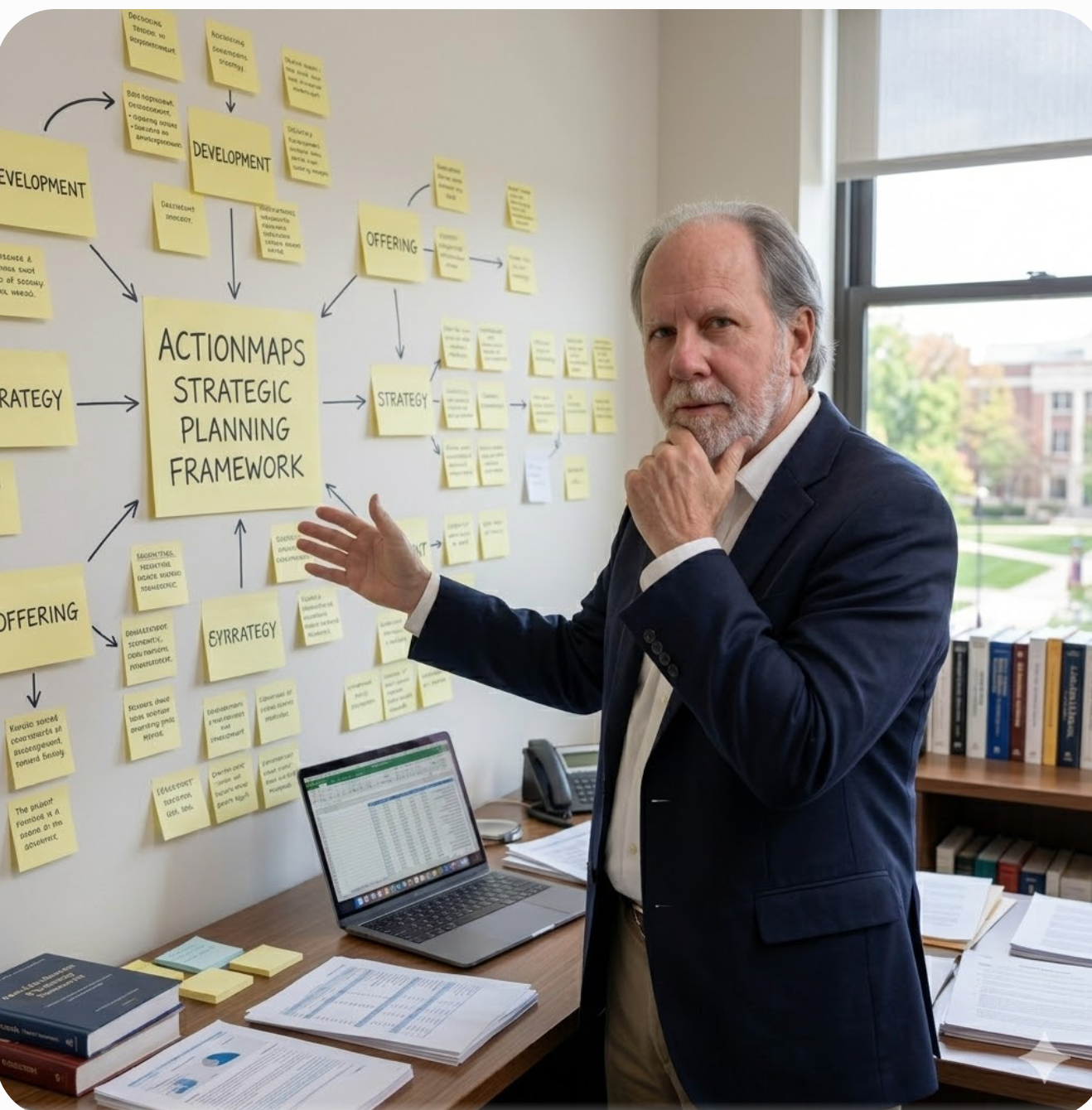
"I've taught strategic planning at the university level for over 25 years. Strategy can be a fairly complex subject and most Fortune 500 companies use teams of consultants to help them. But at the same time I was teaching, I had also begun consulting with interior design firms which, as you know, are almost always small businesses. Seeing the incredible value of a great strategic plan for big businesses, I started to develop a process that would take the best of those Fortune 500 tools, and make them accessible to you. The result was my ActionMap process and the impact on interior design firms, large and small, has been nothing less than profound."
—David Shepherd
Just What Does a Great Strategy Look Like?
At this point you may be wondering what a strategy actually looks like.
Most designers imagine a strategic plan as a thick binder that gets placed on a shelf and forgotten. Others think of it as a mission statement, a collection of goals, or a vague description of where they'd like their firm to be someday.
An ActionMap is none of those things.
Instead, it is a visual representation of the chain of cause and effect that leads from the life you want to live to the specific actions you must take this week.
Every element supports the one above it. Every action has a purpose. Every decision can be evaluated against a larger objective.
The result is a strategic blueprint that connects today's actions to tomorrow's outcomes.
Here's a simplified version of the process:
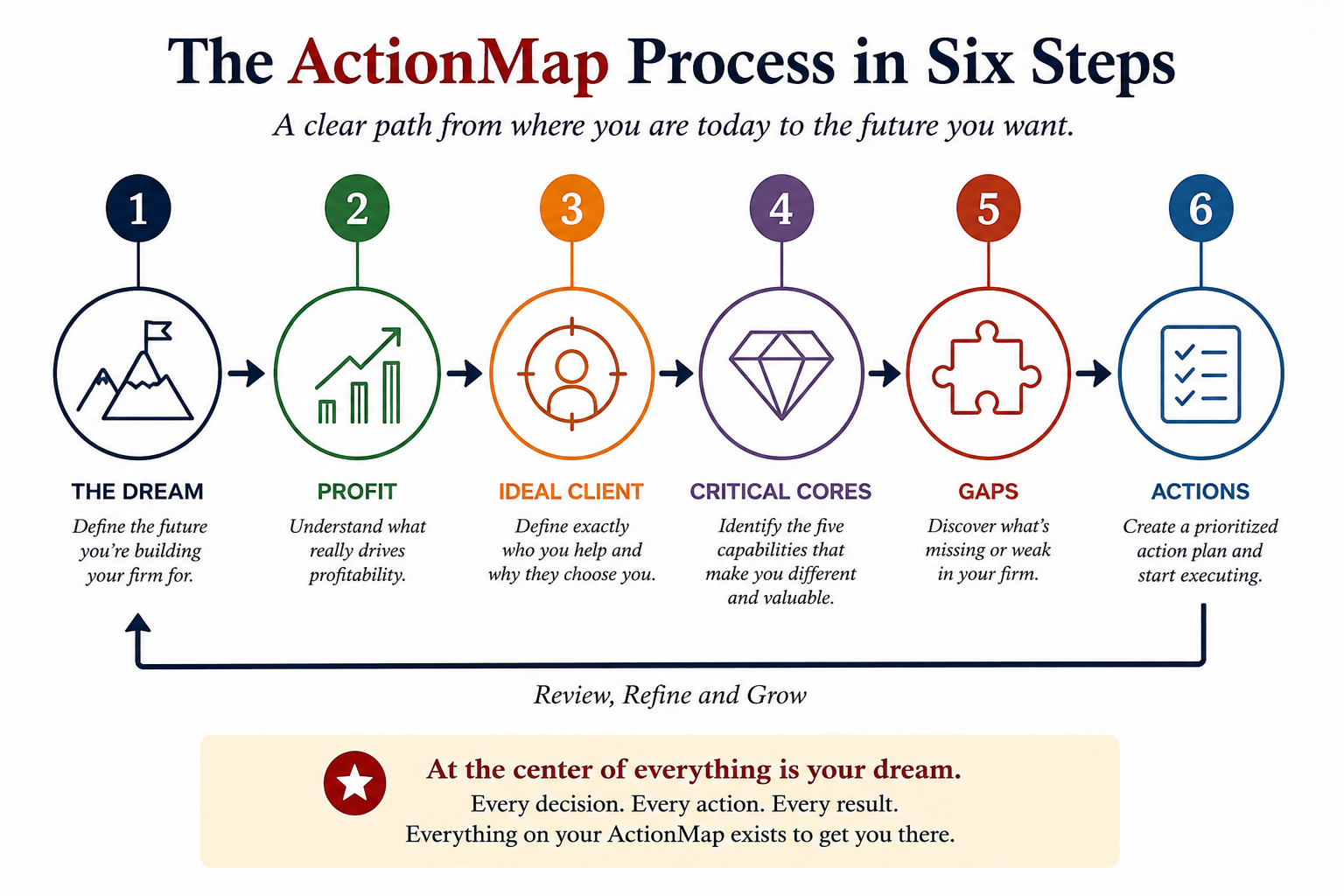
The diagram above is intentionally simple.
During the program, you'll build a far more detailed version tailored specifically to your firm, your market, your clients, your goals, and your opportunities.
What matters for now is understanding the flow.
You begin with the life you're trying to create.
From there, we determine the level of profit required to support it.
We identify the clients most capable of generating that profit, the capabilities that make your firm the logical choice for those clients, the gaps preventing you from fully delivering those capabilities, and finally the specific actions required to close those gaps.
By the end of the process, every important business decision has a place on the map and every action has a reason for existing.
That is why participants often tell me that the greatest benefit of the process is not simply higher profits or better clients, but clarity. For the first time, they understand exactly why they're doing what they're doing and where those efforts are intended to lead.
The question, then, is how you actually build a map like this.
What You’ll Build in Six Weeks
Over six weeks, in a small group of fellow designers, I’ll walk you through building your own ActionMap — the same framework I use in my private engagements. You’ll work through six connected stages:
✓The Dream. Your real goal — and for most owners it’s personal, not professional. A retirement number. Total financial freedom. The beach house. You name it, claim it, and anchor it at the top of your map, because everything below it exists to get you there.
✓Profit. What actually drives it in your firm — which is almost never what your bookkeeper’s reports suggest.
✓The Ideal Client. Exactly who you’re building for, so every other decision gets easier.
✓Critical Cores. The five capabilities you must master and do better than or different from your competitors. That’s the literal definition of strategy — and all five have to be complementary, genuinely supporting one another.
✓Gaps. What’s missing today that’s standing between you and each Critical Core. (One designer’s Critical Core was winning awards — and her Gap turned out to be simple: she needed one part-time person whose only job was finding and submitting award applications.)
✓Actions. You finish with 15 to 25 specific actions that lead, step by step, back up to your Dream.
There’s one more piece I won’t let you skip: Tradeoffs. What you decide not to pursue matters as much as what you commit to. One client desperately wanted a Manhattan office and an 8,000-square-foot retail showroom. With me playing devil’s advocate, neither survived. They got traded off — and her firm grew from 7 employees to 22 over the next two years.
You build the map from the top down, starting with your Dream. You implement it from the bottom up, through daily action. Articulated from the top down; implemented from the bottom up. That’s how real strategy works.
And when you’re done, you’ll tell the story of it in a single breath:
Why Most Designers Never Develop a Strategy —
And Why So Many Never Create Lasting Financial Security
During more than twenty-five years of teaching strategic planning and consulting with interior design firms, I have had the opportunity to observe a wide range of business owners operating under vastly different circumstances. Some built firms that generated significant wealth and personal freedom. Others worked just as hard, displayed just as much talent, and yet never seemed to achieve the financial security they originally envisioned. What surprised me over time was that the difference was rarely attributable to creativity, education, experience, or even work ethic. In many cases, the most financially frustrated designers were among the hardest-working professionals I encountered.
The distinction, more often than not, was strategic clarity. The most successful firms possessed a clear understanding of who they served, what made them genuinely different, which opportunities were worth pursuing, and which opportunities should be deliberately ignored. Their businesses appeared focused because they were focused. Important decisions were made within a coherent framework that connected daily activities to long-term objectives.
By contrast, firms that struggled financially often suffered from a lack of such clarity. They pursued too many opportunities, accepted too many types of projects, and attempted to be too many things to too many people. Rather than moving steadily toward a clearly defined destination, they found themselves reacting to circumstances as they arose. Each individual decision may have appeared reasonable in isolation, but the cumulative effect was a business pulled in multiple directions at once.
What makes this situation particularly frustrating is that most owners already understand the importance of strategy. Rarely have I met a designer who would argue that strategic thinking is unimportant. The problem is not a lack of awareness. The problem is that strategy almost never demands immediate attention. Client projects demand attention. Staffing issues demand attention. Deadlines demand attention. The proposal due next week demands attention. Strategy, by comparison, waits patiently in the background, always available to be addressed tomorrow.
Unfortunately, tomorrow has a way of becoming next month, then next year, and eventually the next decade. Many owners spend years believing they will devote serious thought to the future of their firms once the current project is completed, once the next employee is hired, or once business finally slows down. Yet business rarely slows down. Success often creates additional complexity rather than additional clarity, and the very growth owners seek can leave them with even less time to think strategically about where the business is headed.
As a result, many designers eventually discover that they have built a successful practice without necessarily building the life they intended that practice to support. The projects may be impressive. The reputation may be strong. Revenue may even be substantial. Yet the freedom they imagined, the flexibility they hoped for, or the financial security they expected somehow remains just beyond reach.
This is one reason lasting financial security proves so elusive for many business owners. Wealth is seldom the product of a single brilliant decision. More often, it is the result of hundreds of decisions made consistently over many years, each reinforcing the next and moving the business in a deliberate direction. When those decisions are guided by a coherent strategy, their effects compound. When they are not, progress becomes slower, more difficult, and far less predictable.
The purpose of ActionMaps is not merely to help designers think more strategically. It is to provide a practical process through which strategic clarity can finally be achieved. Rather than allowing the most important decisions to remain indefinitely postponed, the program creates the time, structure, and accountability necessary to make those decisions deliberately. The result is not simply a better plan, but a clearer understanding of how the business should operate, where it should be headed, and how today's actions connect to the future the owner ultimately hopes to create.
No Two ActionMaps are Ever the Same!
One of the first questions designers ask is whether everyone ends up with the same strategy. The answer is no. In fact, after more than twenty-five years of consulting, I have never seen two ActionMaps that were truly alike. What follows are four broad categories of strategic thinking that have emerged repeatedly. Each contains dozens of possible variations, and none is inherently superior to the others.
Below are examples of just a few ActionMap strategies I have helped designers to create, enabling them to dominate a profitable segment of their market. These are, however, only the tip of the proverbial iceberg available.

Trojan Horses
A brilliant strategy can rest on a way to "sneak" into the hearts and minds of high-net-worth clients before landing bigger projects.
✓Media Rooms
✓Gourmet Kitchens
✓Wine Cellars
✓Luxury Garages
✓Home Offices
✓Golf Equipment Rooms
✓Ski-lodge Mud Rooms
✓Unique Kid's Rooms
✓Smart Home Tech

Passionate Lifestyle
Many ActionMap clients have created great strategies that tap into one of their own personal passions and then finding like-minded clients for projects they love.
✓Yachts
✓Equestrian Centers
✓Beach Houses
✓Mountain Lodges
✓Hunting Lodges
✓Outdoor Living
✓Landscape Design
✓Luxury Aircraft

Embedded Partners
Many professionals already have the clients you want. Find a way to "embed" yourself with them, and their clients become yours.
✓Architects
✓Builders
✓Pool Builders
✓Real Estate Agents
✓Local Media
✓Audio/Video Specialists
✓Fine Art Consultants
✓Wealth Managers
✓Private Jet Support

Complex Specs
Designers who are willing to take on long, complex sales cycles and projects with complex specs, will face far fewer competitors
✓Assisted Living
✓Skilled Nursing
✓Private Clubhouses
✓Medical Offices
✓Government Buildings
✓Corporate Design
✓High-end Restaurants
✓Banks & Law Offices
✓Theaters