
See Your Design Practice
Transformed Starting July 22, 2026
Why Do Your Best Clients Choose You?
And Why Do the Others Walk?
Dear Designer,
I’m David Shepherd, university business professor and interior design consultant, and I want to start with the two most important questions any interior designer who wants lasting financial success has to answer:
Think about that. If you truly knew the answer to just those two questions, you'd know everything you need to know about the future of your practice, and your own odds of achieving financial security.
Here's the problem. Most designers can't answer these questions—not clearly. Ask what makes them different and they'll float the same, tired, generalities that every other designer offers. Eye for color, proven track record, we put the customer first, blah, blah, blah.
I'll prove it to you with a story.
Uniquely Identical
Years ago, at one my largest business conferences for designers, I asked about 400 attendees to think about what made them truly unique. Several raised their hand and I called on one. She described how her ability to use Revit to create 3D renderings set her apart.
I then asked the room how many others used the same or similar software to achieve the same effect.
About 75 hands went up.
I repeated the experiment six more times with the same result. These designers hadn't created uniqueness at all. In fact, they're what author and Harvard strategic planning professor Youngme Moon would call, "Uniquely identical."
Do I even need to ask how in the world a client is supposed to
be able to pick you out of a crowd...if you can't?
You must not just have a capability or two; you must have a unified set of skills that make you stand out from the pack. You must make it not just a happy coincidence that the client choose you, but an inevitability!
What Makes You Different?

Don't expect a client to discern what makes you different—if you can't!
And there's only one thing that can make you different—a great strategy. Yes, strategy that overused, high-sounding MBAish word is the key to your future. With a great one, you simply cannot fail. Without one, there is no way to succeed.
Think about that. And let me be precise, because the word "strategy" is terribly abused. It is not a mission statement, not a plan, not a goal, not a tag line. I'll get to the definition in a moment, but let's deal first with the benefits. A clear and compelling strategy defines who you are, what makes you genuinely different, exactly who you're for, and even specifies exactly what you must offer such that your ideal clients simply have no choice. They have to choose you!
A great strategy doesn't describe your reality; it creates it.
And here's the part most people rarely think about: the strategy you develop and commit to will determine whether or not you are someday able to retire on your own terms. Whether you'll create true financial independence, or be chasing that next project in your 70's. Keep in mind that despite all the apparent changes such as social media, online design, AI, etc., the laws of business success are like the laws of physics—they NEVER CHANGE! Apples still fall from the tree, and profits still result from one thing and one thing only, BEING DIFFERENT!
How Did The Breakthrough Happen?
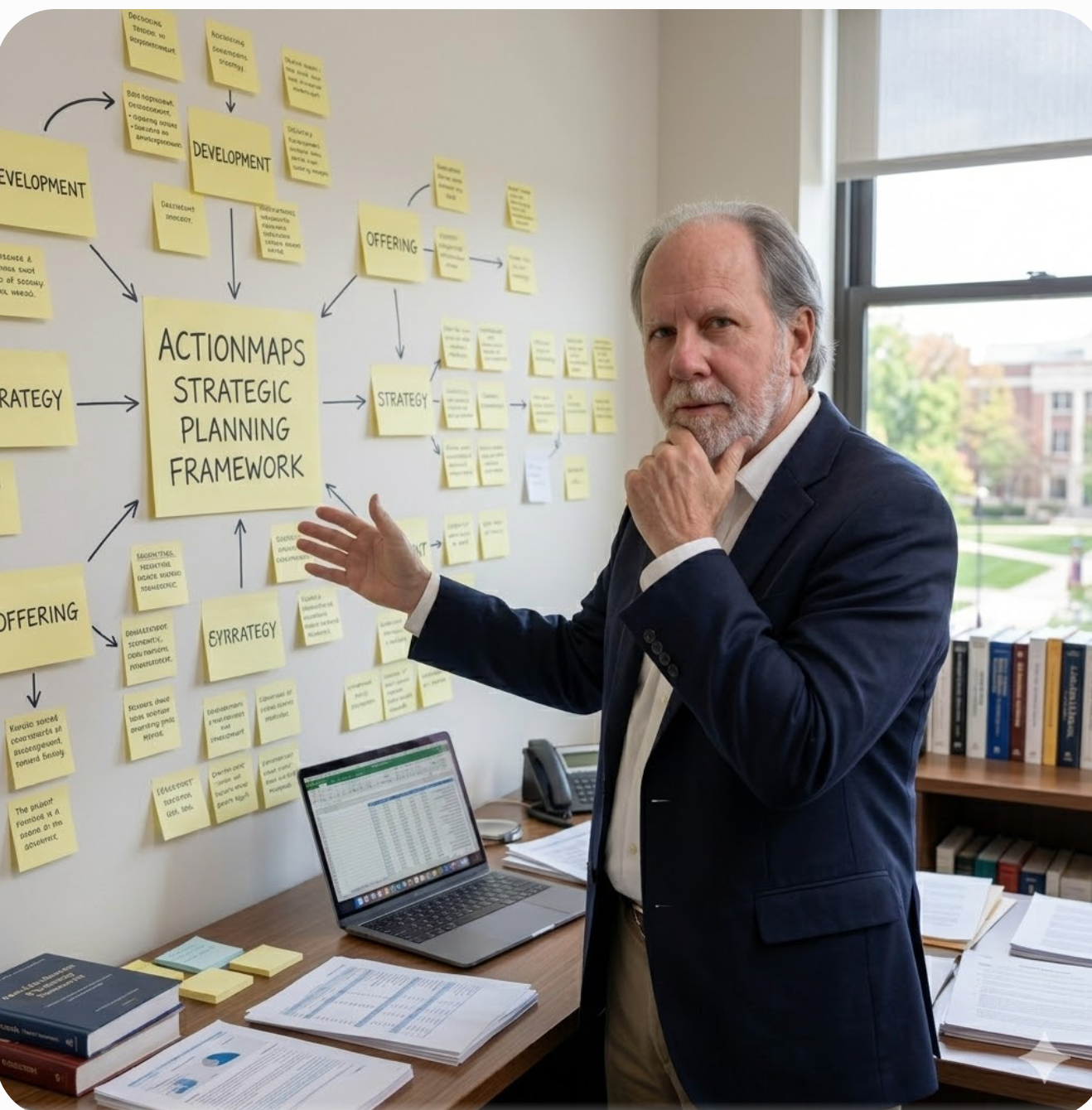
From the university classroom,
to the interior designer's desk!
"I've taught strategic planning at the university level for over 25 years. Strategy can be a fairly complex subject and most Fortune 500 companies use teams of consultants to help them. But at the same time I was teaching, I had also begun consulting with interior design firms which, as you know, are almost always small businesses. Seeing the incredible value of a great strategic plan for big businesses, I started to develop a process that would take the best of those Fortune 500 tools, and make them accessible to you. The result was my ActionMap process and the impact on interior design firms, large and small, has been nothing less than profound."
—David Shepherd
Just What Does a Great Strategy Look Like?
At this point you may be wondering what a strategy actually looks like.
Most designers imagine a strategic plan as a thick binder that gets placed on a shelf and forgotten. Others think of it as a mission statement, a collection of goals, or a vague description of where they'd like their firm to be someday.
An ActionMap is none of those things.
Instead, it is a visual representation of the chain of cause and effect that leads from the life you want to live to the specific actions you must take this week.
Every element supports the one above it. Every action has a purpose. Every decision can be evaluated against a larger objective.
The result is a strategic blueprint that connects today's actions to tomorrow's outcomes.
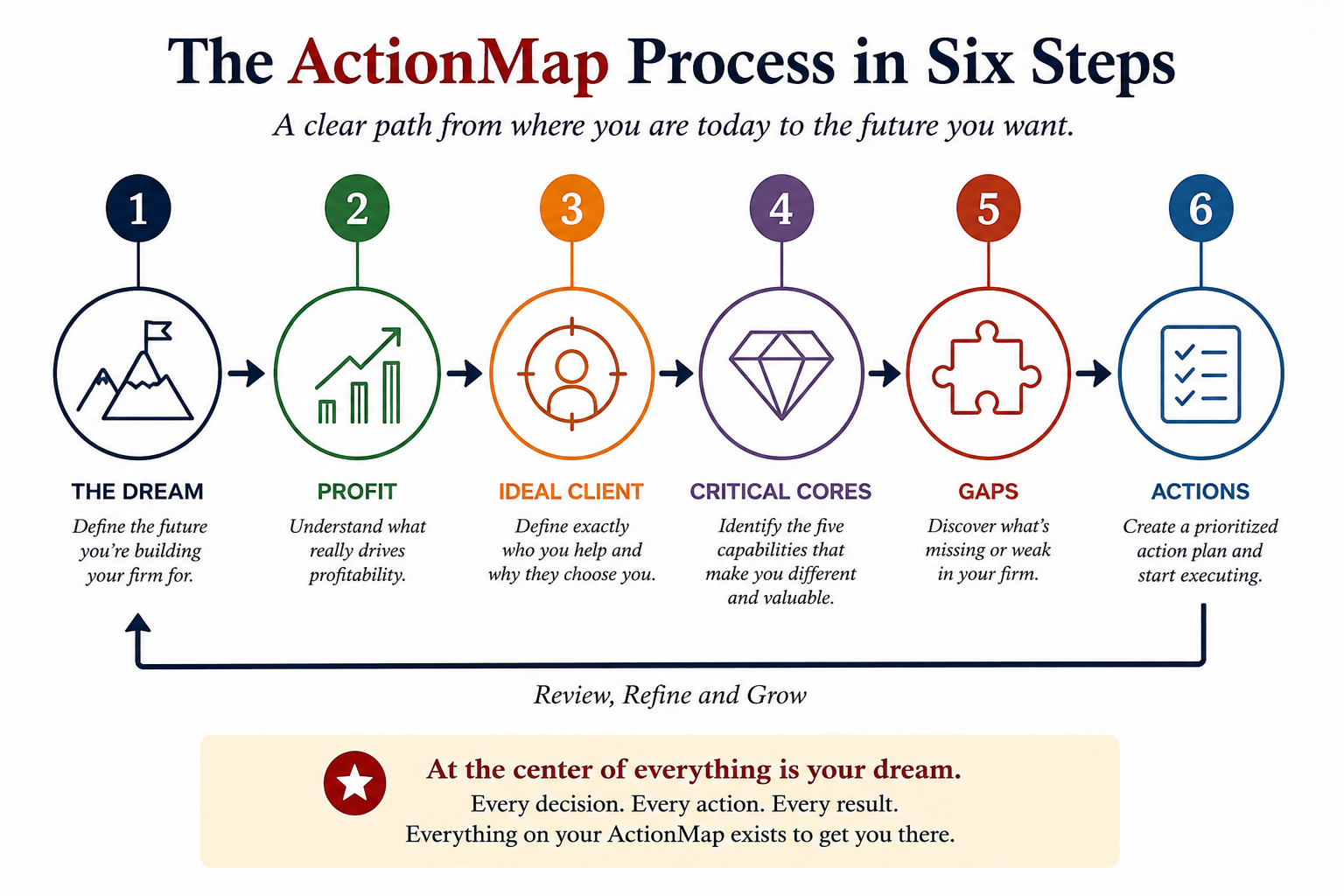
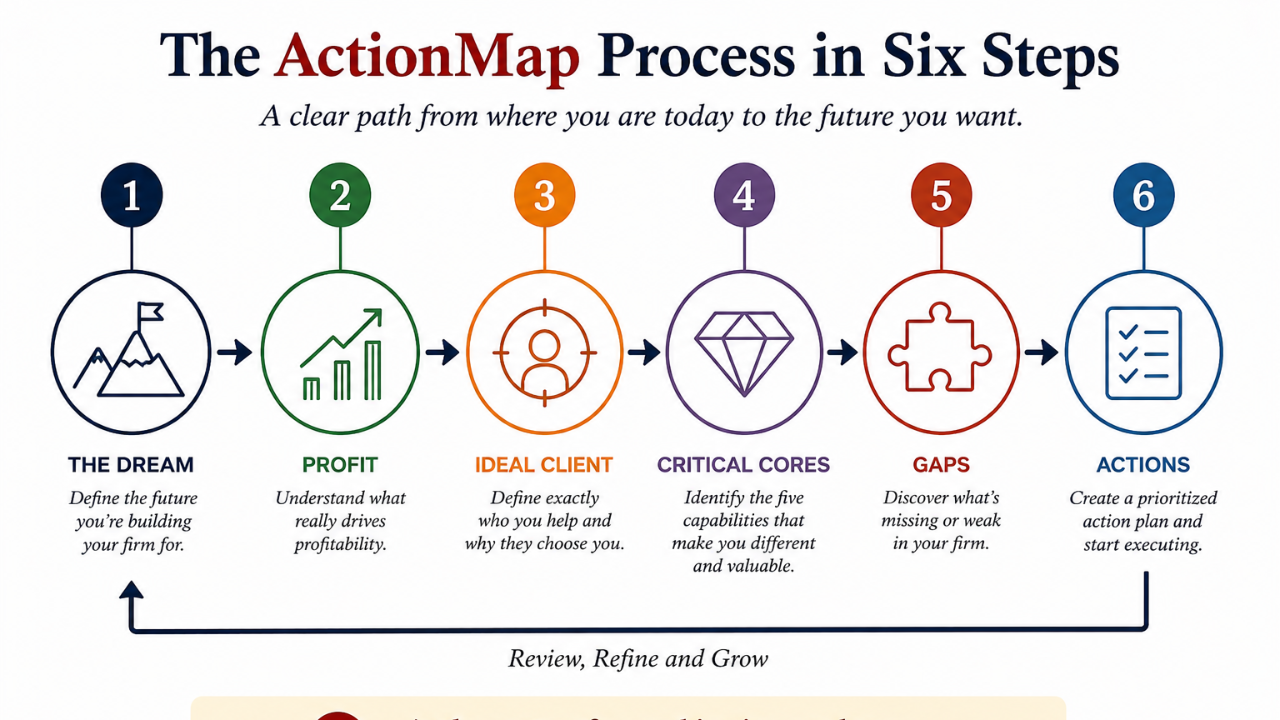
Here's a simplified version of the process:
No Two ActionMaps are Ever the Same!
One of the first questions designers ask is whether everyone ends up with the same strategy.
The answer is no.
The strategy you build will be yours alone. In twenty-five years of working with designers, I've never seen two ActionMaps that were truly alike — because no two designers have the same strengths, the same market, or the same vision of the life they're trying to build.
You're not choosing from a menu. You're building something that could only belong to you — a position in your market so specific and so well-constructed that the right clients recognize you immediately and the wrong ones self-select out.
The result is a firm that doesn't compete. It dominates its corner of the market. And that's where wealth comes from.
The diagram above is intentionally simple.
During the program, you'll build a far more detailed version tailored specifically to your firm, your market, your clients, your goals, and your opportunities.
What matters for now is understanding the flow.
You begin with the life you're trying to create.
From there, we determine the level of profit required to support it.
We identify the clients most capable of generating that profit, the capabilities that make your firm the logical choice for those clients, the gaps preventing you from fully delivering those capabilities, and finally the specific actions required to close those gaps.
By the end of the process, every important business decision has a place on the map and every action has a reason for existing.
That is why participants often tell me that the greatest benefit of the process is not simply higher profits or better clients, but clarity. For the first time, they understand exactly why they're doing what they're doing and where those efforts are intended to lead.
The question, then, is how you actually build a map like this.
Why Most Designers Never Develop a Strategy —
And Why So Many Never Create Lasting Financial Security
In twenty-five years of teaching strategic planning and consulting with interior design firms, I've seen something that still surprises people when I say it out loud: the most financially frustrated designers are rarely the least talented. Often they're the most talented. And the hardest working.
The difference, almost without exception, is strategic clarity.
The successful firms knew exactly who they served, what made them genuinely different, and which opportunities were worth ignoring. Every decision connected to a larger direction. The struggling firms pursued everything, committed to nothing, and found themselves reacting to whatever walked in the door.
Here's the part that makes this so hard to fix: you already know you need a strategy. Every designer I've ever worked with knows it. The problem is that strategy never demands attention today. The client call does. The deadline does. The staffing problem does. Strategy waits patiently for tomorrow — and tomorrow has a way of becoming next year, and next year has a way of becoming never.
The result: a successful practice that somehow never produces the life it was supposed to fund.
That's what ActionMaps is built to fix.
Cohort Begins July 22, 2026
Places are limited
Remaining in this Cohort
Select Your Best Option Below
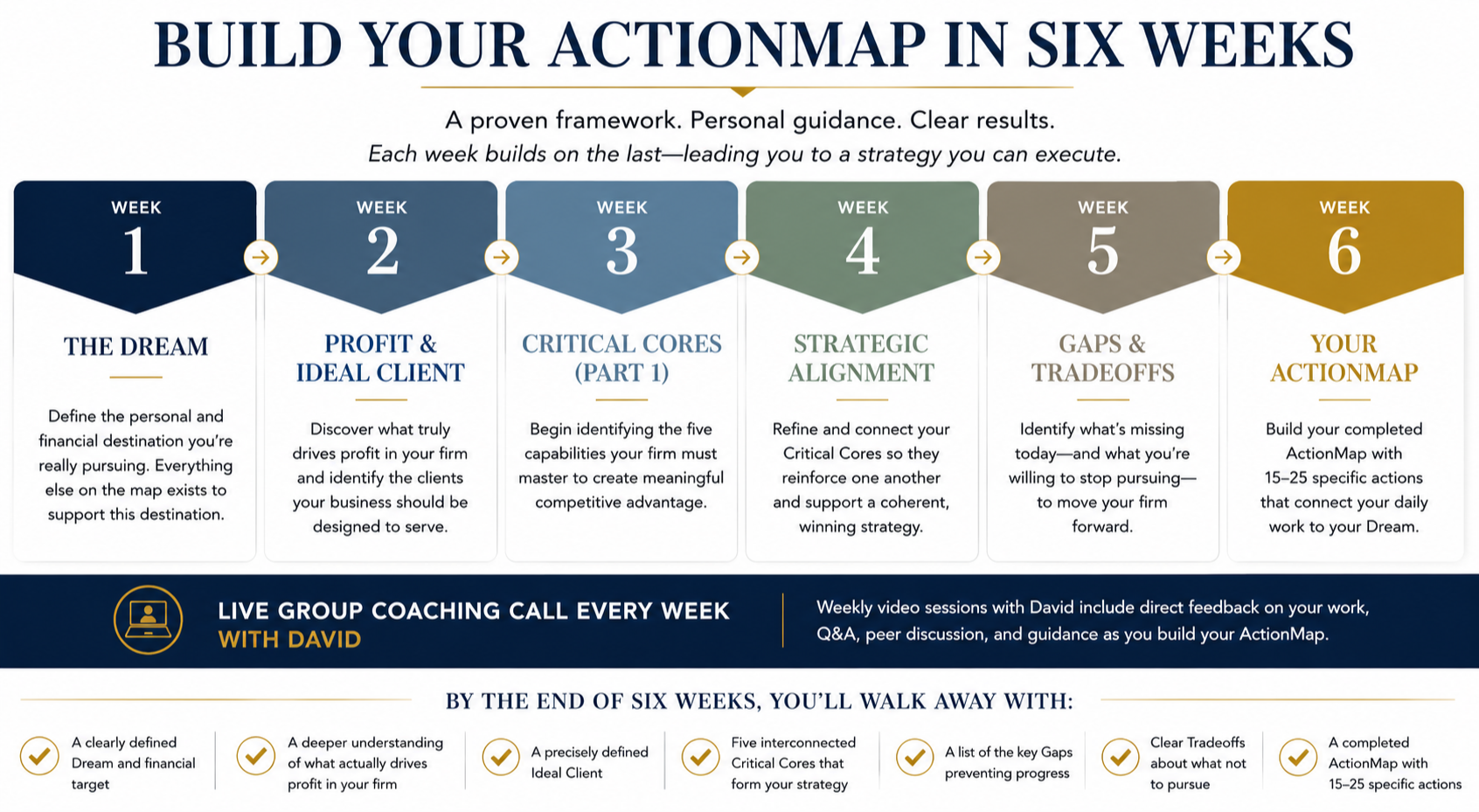
ActionMaps 6-Week Program
Here's all the information you'll need to get ready for your upcoming six-week ActionMaps Program with David Shepherd. David will reach out personally (usually same day) to set up a 15-minute orientation call, and six 50-minute progress sessions throughout the program.